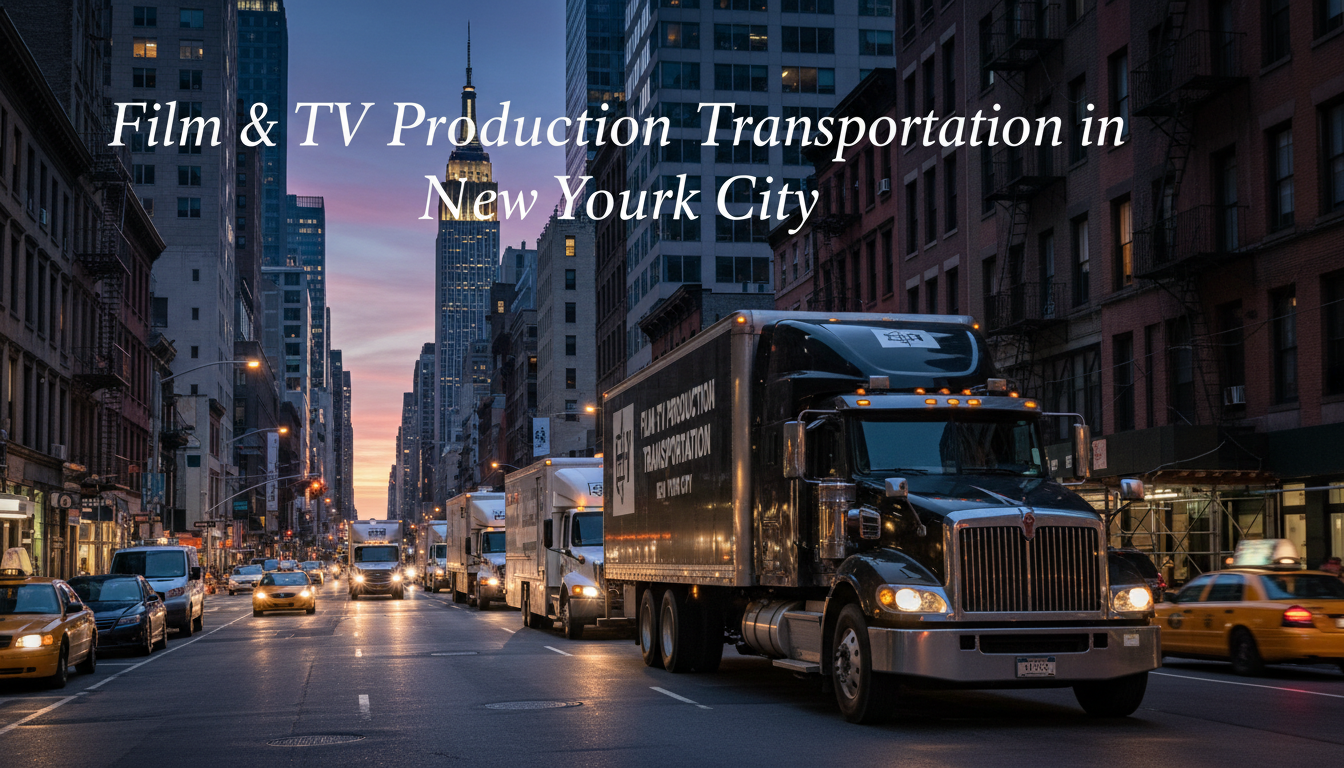
Film & TV Production Transportation in New York City
New York City has long been one of the most filmed places on earth. From the gritty streets of the Bronx to the gleaming towers of Midtown, the city’s backdrop is practically irreplaceable — and every year, hundreds of productions set up shop here to capture it. But behind every great shot is an enormous logistical operation, and film & TV production transportation in New York City sits right at the heart of it. Getting people, equipment, and schedules aligned across one of the world’s most complex urban environments takes experience, local knowledge, and the right partners.
Why Production Transportation Is More Complex in NYC Than Almost Anywhere Else
Most cities have traffic. New York has traffic as a way of life. Add in filming permits, union rules, location scouts spread across five boroughs, and a crew that might need to move from a Brooklyn studio at 4 a.m. to a Midtown rooftop by noon — and you start to understand why transportation logistics can make or break a production day.
The city’s density is both its appeal and its challenge. Streets that look passable on a map can be blocked by a delivery truck, a film crew’s own production vehicles, or a street fair with no advance notice. Experienced production transportation coordinators factor in this unpredictability as a baseline assumption, not an exception.
The Multi-Borough Reality
New York isn’t one city — it’s five boroughs with distinct characters, infrastructure quirks, and permit requirements. A production filming in Staten Island one day and Long Island City the next is essentially navigating two different logistical environments. Local drivers who know these streets intimately — not just the GPS route — are worth their weight in gold.
Productions that underestimate borough-to-borough travel time often burn daylight and budget simultaneously. A 12-mile drive from Astoria to the financial district can take 20 minutes or 90, depending on the day, the hour, and what’s happening in between.
Key Transportation Roles on a Film or TV Production
Understanding who does what helps productions budget correctly and avoid gaps in their logistics chain.
Transportation Coordinator
This is the person responsible for the entire transportation department. They manage vehicle hiring, driver scheduling, fuel logistics, and communication with the production office. On large studio productions, this role is a full-time position that starts months before principal photography.
Transportation Captain
Often working directly under the coordinator, the captain handles day-to-day operations on set — making sure talent vehicles, camera cars, and equipment trucks are where they need to be when they need to be there.
Picture Cars
These are the vehicles that actually appear on screen. Sourcing, insuring, and moving picture cars is its own specialty within production transportation.
Talent Vehicles and Set Transportation
Stars and principal cast typically have dedicated vehicles. Supporting cast, background artists, and crew often travel in vans or shuttles that follow the shooting schedule.
What About Smaller Productions?
Independent films, commercial shoots, and branded content productions often don’t have the budget for a full transportation department. In these cases, they typically hire a transportation service directly — a company with professional drivers experienced in production work. The key difference between a standard car service and a production-experienced one is understanding set etiquette, confidentiality, schedule flexibility, and the specific demands of a shoot day.
Navigating NYC Film Permits and Transportation Regulations
The Mayor’s Office of Media and Entertainment (MOME) issues filming permits in New York City, and those permits often have transportation implications. A permitted location may restrict where production vehicles can park, how long they can remain, and what size vehicles are allowed on certain streets.
This isn’t bureaucracy for its own sake. New York City has finite curb space, and production vehicles — from trailers to equipment trucks — can easily block traffic lanes, loading zones, and fire hydrants if not properly staged. Permit conditions are there to manage the production’s footprint in a dense urban environment.
What Productions Need to Know Before Day One
-
- Parking and staging: Know where your vehicles are allowed to park before the crew arrives. Running around looking for legal spots at 5 a.m. wastes everyone’s time.
-
- Street closures: If your permit includes a partial or full street closure, coordinate your transportation routes around it in advance.
-
- Neighbor notification: Many productions are required to notify local businesses and residents. If transportation is causing disruptions, complaints can lead to permit revocation mid-shoot.
-
- Truck size restrictions: Certain streets — particularly in older residential neighborhoods — have weight and length restrictions that affect equipment vehicle routing.
Executive and Talent Transportation: Setting the Standard
When a studio sends a high-profile actor or director to New York for a shoot, the expectations around transportation are clear. Professionalism, punctuality, discretion, and comfort are non-negotiable. A missed pickup or a driver who doesn’t know where they’re going isn’t just an inconvenience — it can set a negative tone that ripples through the entire production day.
The best production transportation services in NYC treat every talent pickup like a premium car service call. That means clean, well-maintained vehicles, drivers who are familiar with the city and with set protocol, and a communication chain that keeps the production coordinator informed in real time.
What Good Talent Transportation Actually Looks Like
It starts the night before. A professional driver confirms the pickup details, maps the route considering traffic patterns for that specific time of day, and has a backup plan if the primary route is disrupted. On the day, the driver arrives early — not on time, early — and waits without creating pressure on the passenger. There’s no fumbling with apps or asking for directions while the talent is in the car.
These details matter. Talent who arrive relaxed and on time perform better. It sounds simple, but it’s a real, measurable impact on production quality.
Production Crew Shuttles and Base Camp Logistics
On large productions, base camp — the cluster of trailers, holding areas, and crew facilities near the set — can be located several blocks or even miles away from the actual shooting location. Crew shuttles run continuously throughout the day, moving people between base camp, set, catering, and parking areas.
Managing these shuttle routes in New York City requires constant adaptation. A block that was clear at 6 a.m. may be inaccessible by 10 a.m. due to a delivery window or a change in the permit area. Experienced drivers communicate with each other and with the transportation captain to adjust routes in real time.
Getting this right keeps the set moving. When crew members are waiting 20 minutes for a shuttle that should take five, it creates delays — and in a city where every production day costs tens of thousands of dollars, delays are expensive.
Equipment and Camera Car Considerations
Moving production equipment through New York City is a specialized operation. Camera trucks, lighting rigs, grip equipment, and generator vehicles all require drivers with commercial licenses and, in many cases, knowledge of weight-restricted routes and low-clearance tunnels.
The Brooklyn-Battery Tunnel, for example, has specific height restrictions. Several Midtown crosstown streets have turning radius challenges for long vehicles. A driver who doesn’t know these constraints can find themselves stuck — literally — in a situation that grinds the day’s schedule to a halt.
Camera cars, which are specialized vehicles used to capture moving shots, require an entirely different skill set. These drivers work closely with the camera operator and director of photography, often driving at precise speeds and following specific choreography to capture the shot. It’s a niche role, but productions that need it absolutely cannot improvise.
Frequently Asked Questions
What’s the difference between a production transportation company and a regular car service?
A production-specific transportation company understands the unique demands of a film or TV shoot — including unpredictable schedule changes, on-set etiquette, discretion with talent, and the need to coordinate with a production’s transportation department. Regular car services are excellent for point-to-point travel but aren’t typically set up to handle the fluid, high-pressure environment of an active production.
How far in advance should I book production transportation in NYC?
For large productions, transportation planning typically begins during pre-production — sometimes six to eight weeks out. For smaller shoots or individual talent pickups, a week’s notice is generally workable, though for high-demand dates or large vehicle requirements, earlier is always better. New York City is a busy market.
Do production drivers in NYC need special licensing or certifications?
Drivers operating commercial vehicles — trucks, vans over a certain weight, passenger vehicles for hire — need the appropriate commercial driver’s license (CDL) or TLC (Taxi and Limousine Commission) licensing depending on the vehicle type and use. Reputable production transportation companies ensure all their drivers have the correct credentials before putting them on a production.
Is it worth hiring a dedicated transportation coordinator for a small indie production?
It depends on the scale, but for shoots lasting more than a week or involving multiple locations across the city, having a single point of contact managing transportation logistics usually pays for itself in avoided confusion and lost time. For very small shoots, working with a professional transportation service that has experience in production work can fill much of that coordination role.
What happens when production schedules change last minute — which happens constantly?
Good production transportation companies build flexibility into their operations as a matter of course. Experienced drivers and coordinators know that a scene that was scheduled for 2 p.m. might be pushed to 6 p.m. or moved to a different location entirely. Clear communication channels between the transportation team and the production office are essential — problems usually arise when those lines of communication break down, not because of the schedule change itself.
Conclusion
Film & TV production transportation in New York City is one of those behind-the-scenes disciplines that only gets noticed when something goes wrong. When it’s working well, talent arrives on time and in good spirits, equipment reaches the set without incident, crew shuttles run smoothly, and the production can focus entirely on the creative work. When it breaks down, the ripple effects touch every department.
The city’s complexity is also its richness. There’s nowhere else in the world quite like it for production, and the transportation professionals who operate here have developed genuine expertise in making the impossible feel routine. Whether you’re coordinating a network television series, a feature film, or a one-day commercial shoot, working with people who understand both New York and production is one of the smartest investments you can make in a smooth, professional operation.
Ready to book or have questions? Whether you’re planning a full production or just need reliable, professional transportation for talent and crew, our team is here to help. Get in touch — email us at book@bubzlimos.com or call +1 (929) 541-5558 and we’ll be happy to discuss your needs, answer your questions, or put together a quote. We’d love to be part of your next production.
Related Posts
 US Open Transportation New York City September
 VIP Event Transportation Across New York City
 Corporate Event Transportation in New York City: Fleet Options Explained
 Armored Vehicle Transportation in New York City for VIP Security
 Medical Transportation Service in New York: Comfort & Reliability First
 The 2026 Cadillac CT5 Is Redefining What Luxury Ground Transportation Looks Like in New York City
 Book Your Super Bowl Luxury Transportation in New York City
 Private Medical Transportation in New York