
Luxury Suburban Service for Group Travel
Corporate Limo Service in NYC: How Executive Ground Transportation Actually Works
Corporate limo service in NYC means reliable, licensed, professionally chauffeured ground transportation for business travelers — covering airport transfers, client pickups, roadshows, and office-to-office runs across Manhattan, Queens, Brooklyn, and beyond. The difference between a corporate account and a one-off ride is structure: confirmed itineraries, consistent vehicles, verifiable licensing, and a dispatcher who already knows your executive’s flight schedule before the wheels touch down at JFK.
If you’re an executive assistant managing ground transportation for a C-suite, a law firm coordinator handling client arrivals at LaGuardia, or an office manager booking a quarterly off-site in Westchester, this guide explains what professional corporate car service in New York actually looks like — including the compliance details that protect your company, not just the comfort details that look good in a pitch deck.
Why Corporate Ground Transportation in New York Is Different from Everywhere Else
New York is operationally unlike any other market. Manhattan curbside restrictions make drop-offs in Midtown a negotiation — certain blocks around Rockefeller Center or the Financial District restrict commercial vehicles during rush hours, and an unlicensed car getting ticketed in front of your client’s building is not a good look. Queens-to-Manhattan routing via the Queens–Midtown Tunnel varies by 20 to 40 minutes depending on time of day, and the BQE through Brooklyn can stall entirely on Friday afternoons when a Long Island weekend exodus hits all at once.
Corporate travel in this city rewards preparation. A chauffeur who has worked the Van Wyck to JFK hundreds of times knows which exit to take when Terminal 4 arrivals are backed up. That’s not a feature you’ll find listed on a ride-share app — it’s institutional knowledge that comes from operating here every day.
What TLC Licensing Actually Means for Your Company
Every for-hire vehicle operating commercially in New York City is required to be licensed through the NYC Taxi & Limousine Commission. This isn’t a formality. TLC licensing requires vehicles to pass regular inspections, and — critically for corporate accounts — TLC-licensed chauffeurs must pass background checks and drug testing as part of the licensing process. When you’re putting a senior partner or a visiting client in a car, you are not guessing at driver vetting.
For interstate runs — Atlantic City, the Poconos, Westchester, Connecticut — the operator also needs FMCSA/USDOT registration and commercial liability insurance that covers those miles. If a carrier can’t produce proof of both, your company’s legal exposure in an incident isn’t zero. Asking for those credentials before you sign a contract is standard due diligence, and any legitimate operator will hand them over without hesitation.
The Fleet That Actually Makes Sense for Executive Travel
Bubz Limos runs a 2026 Mercedes-Benz GLS 450 as part of its executive lineup — a full-size luxury SUV that handles the kind of Midtown traffic and narrow Financial District streets that stretch limousines can’t navigate cleanly. For larger groups — a management team heading to a Westchester conference, a delegation transferring between JFK and a Midtown hotel — executive Sprinter vans keep the group together without requiring a party bus footprint.
Stretch limousines still make sense for specific corporate scenarios: client entertainment, a CEO’s anniversary dinner where the company is footing the bill, or a financial roadshow where optics matter alongside logistics. The right vehicle is the one that fits the trip, not the most expensive option in the garage.
Airport Transfers: JFK, LaGuardia, and Newark Done Right
How Flight Tracking Works on a Corporate Account
On airport pickup runs, a professional corporate car service monitors inbound flights in real time. The chauffeur isn’t dispatched based on the originally scheduled arrival time — they’re staged based on where the flight actually is. That means if your executive’s Delta flight from O’Hare pushes back 35 minutes at Midway, the car adjusts. Nobody is circling Terminal 4 for an extra half hour, and nobody is standing at baggage claim wondering where the driver is.
Standard practice on airport pickups: the chauffeur is staged at least 15 minutes before projected wheels-down, meets the traveler inside (flight number and name board confirmed), and has the route pre-checked for delays before the traveler clears customs. The Van Wyck to JFK can move in 20 minutes at 6am or take 55 minutes at 5:30pm on a Thursday — those aren’t the same trip, and the staging time reflects that.
Outbound Airport Runs: Building in the Right Buffer
For departures, industry standard is a 45-to-60-minute buffer before the recommended check-in window, factoring in pickup location and realistic drive time. An executive leaving from Long Island City for an international flight out of JFK technically has a short drive — but if that departure falls between 7am and 9am on a weekday, the Van Wyck approach and terminal circulation can easily add 25 minutes. A good dispatcher accounts for that, not just the miles.
A Worked Scenario: Coordinating a Three-Stop Executive Day
Here’s how a realistic corporate booking plays out. A law firm in Astoria needs ground transportation for a visiting client flying into JFK at approximately 2:00 PM, with a 4:00 PM meeting in Midtown and a dinner in the Financial District at 7:30 PM.
- Flight monitoring begins two hours before scheduled arrival. If the flight is on time, the chauffeur is staged at Terminal 4 by 1:45 PM with the client’s name on a meet board. If the flight is showing a 45-minute delay, dispatch adjusts staging accordingly — no wasted time, no panic call from the client.
- JFK to Midtown routing is checked the night before. For a 2:15 PM exit from JFK, the Van Wyck to the Queens–Midtown Tunnel is typically the cleanest route. Drive time to a 6th Avenue address in Midtown runs approximately 40–55 minutes depending on tunnel approach traffic, which puts arrival comfortably before the 4:00 PM meeting.
- Midtown staging is pre-confirmed. The chauffeur knows which blocks permit commercial vehicle waiting and which are restricted during business hours. There’s no circling — the car is staged at a confirmed hold point and the client texts when they’re exiting the building.
- Midtown to Financial District in the evening. A 7:00 PM departure from Midtown for a 7:30 PM dinner in the Financial District is realistic if the route avoids the worst of the evening theatre-district congestion. The chauffeur takes the FDR southbound rather than surface streets through the West Village. Estimated drive: 20–30 minutes.
That’s three legs, two traffic windows, one client, and zero improvisation. That’s what a coordinated corporate account looks like in practice.
What a Corporate Account Agreement Should Include
Verbal agreements don’t hold up when a car doesn’t show for a 5:30 AM flight. Before the first booking is confirmed, ask for a written agreement that includes:
- Itemized rate structure — hourly minimums, per-trip rates, and whether deadhead (garage-to-pickup) mileage is charged
- Gratuity policy stated explicitly — is it included, or expected on top of the quoted rate?
- Cancellation and modification windows — what’s the penalty for a same-day cancel vs. 48 hours’ notice?
- Chauffeur substitution policy — if your regular driver isn’t available, what’s the vetting process for whoever replaces them?
- Proof of TLC licensing, USDOT registration (for interstate legs), and commercial liability insurance
- Billing and invoicing format — net-30 corporate invoice, corporate card on file, or per-trip billing?
None of these are unreasonable requests. An operator who pushes back on any of them is telling you something important about how they operate.
Corporate Car Service Beyond the Airport: Other Use Cases Worth Knowing
Client Entertainment and Event Transportation
December is the heaviest month for corporate car demand in New York — holiday parties, client dinners, and year-end events stack up from the second week onward. A Financial District firm moving 20 people to a venue in Williamsburg, a Midtown office taking a team to a Forest Hills dinner, a law firm hosting clients from out of town during the week of Christmas — all of these require confirmed vehicles well in advance. Booking a party bus or Sprinter for corporate group moves in December without a confirmed reservation is optimistic at best.
Roadshows and Multi-Day Corporate Travel
Investment banks, private equity firms, and consulting practices running roadshows across multiple cities typically need ground transport that can handle both in-city legs and runs to regional airports — Newark for United, JFK for international, LaGuardia for domestic East Coast connections. Having a single point of contact who already has the itinerary and knows which terminal means one less logistical variable on a high-stakes travel week.
Executive Sprinter for Team Offsite Runs
A Sprinter van handles the Queens-to-Westchester or Jamaica Estates-to-Hudson Valley runs that come up when a company books an offsite retreat. It keeps the team together, allows working time in transit, and doesn’t require anyone to navigate an unfamiliar route after a long day of sessions. Summer and early fall are peak periods for these runs — June through October maps directly onto the corporate offsite calendar, not just the wedding season.
Frequently Asked Questions About Corporate Limo Service in NYC
How far in advance should I book corporate car service in New York?
For routine airport transfers, 24–48 hours is workable on most days. For high-demand periods — December holiday season, major conference weeks in Midtown, prom season in May, or any Friday before a holiday weekend — book at least a week out. Multi-vehicle or multi-day roadshow bookings should be confirmed as early as the itinerary is locked.
Do you charge for travel time from the garage to the pickup location?
Some operators include deadhead mileage in the base rate; others itemize it separately. Ask before you confirm. A written quote should specify whether the clock starts when the chauffeur departs the garage or when they arrive at your pickup address — those can be two different numbers, especially for pickups in outer Queens or Long Island.
What happens if my executive’s flight into JFK is significantly delayed?
On a flight-tracked booking, the chauffeur’s staging time adjusts to the live updated arrival. If a delay is substantial (2+ hours), a legitimate operator will contact you to discuss options — holding the booking, rescheduling, or adjusting the vehicle if the original window conflicts with another booking. The key is real-time communication, not a driver sitting in a JFK cell lot for three hours without anyone knowing.
Can you handle recurring corporate accounts with monthly invoicing?
Yes — corporate accounts with regular transportation needs can typically be set up with consolidated invoicing rather than per-trip charges. Confirm the billing cycle, what documentation comes with each invoice (trip logs, vehicle used, chauffeur details), and whether your company’s AP department needs a W-9 on file. Getting the admin right upfront saves significant back-and-forth later.
Is a party bus appropriate for corporate group transport, or does that look unprofessional?
It depends entirely on the context. A team moving between a company holiday party and an after-party venue? A party bus works. A group of clients being transferred to a formal corporate dinner? An executive Sprinter or black car fleet is the right call. The vehicle sends a signal — match it to the occasion, and discuss the event context with the dispatcher so they can recommend accordingly.
What to Do Next
If you’re setting up corporate ground transportation for the first time, or moving away from a service that’s been inconsistent, the first step is a direct conversation — not a quote form. Describe your typical use cases, your key routes, and your billing requirements, and get a clear answer on licensing, insurance, and contract terms before any money changes hands. The logistics of corporate travel in New York are complicated enough without the car service being a variable.
Bubz Limos works with corporate clients across Queens, Manhattan, Long Island, and Westchester — from routine JFK runs to multi-day roadshow support. To start a conversation about setting up an account or to get a quote for an upcoming booking, email book@bubzlimos.com or call +1 (929) 541-5558.
Related Posts
 Private Jet Charter and Limo Service NYC: The Ultimate Luxury Travel Experience
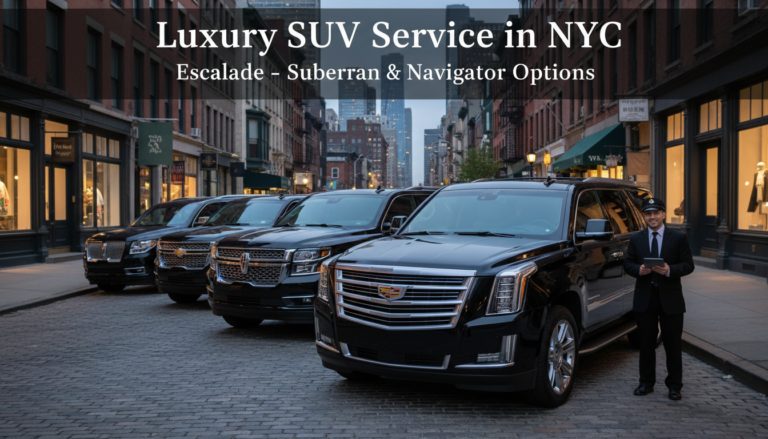 Luxury SUV Service in NYC: Escalade, Suburban & Navigator Options
 Exclusive Super Bowl Limo Service NYC for VIP Groups
 Arrive in Luxury to Beyoncé’s NJ Concert: Party Bus & Premium SUV Rentals by Bubz Limousine!
 Elevate Group Travel with the Luxury Ford Shuttle Bus and Bubz Limos NYC
 Travel in Style and Space with the Tour Bus from Bubz Limos NYC
 Elevate Your Travel Experience: Inside Bubz Limos NYC’s Luxury Ford Shuttle Bus
 Explore NYC in Style: Discover the Luxurious Bubz Limos Tour Bus Experience!