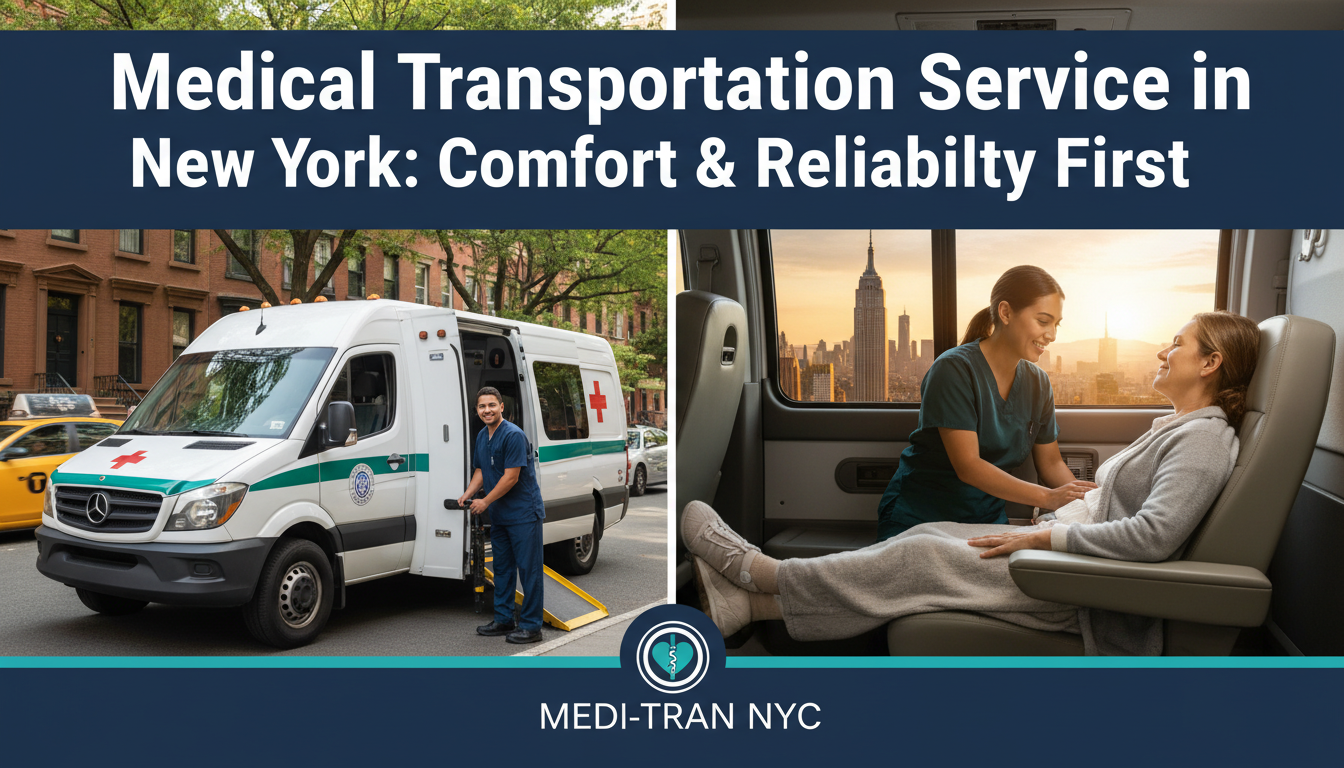
Medical Transportation Service in New York: Comfort & Reliability First
When health is on the line, getting to your appointment on time isn’t just a matter of convenience — it’s a matter of care. Medical transportation service in New York fills a critical gap for patients who need more than a standard taxi or rideshare can offer. Whether you’re recovering from surgery, managing a chronic condition, or supporting an elderly parent through ongoing treatment, the right transport can make the entire experience less stressful and significantly safer.
New York’s healthcare landscape is vast. The city is home to over 60 hospitals, hundreds of specialty clinics, and major medical centers like NewYork-Presbyterian, NYU Langone, and Memorial Sloan Kettering. Getting between these facilities — or simply getting to them from home — requires a transport solution that understands medical needs, not just traffic routes.
What Is Medical Transportation and Who Actually Needs It?
Medical transportation refers to any vehicle service designed specifically to assist patients getting to and from healthcare appointments, procedures, or facilities. It goes well beyond point-A-to-point-B travel.
The Difference Between Standard and Medical Transport
A standard rideshare driver won’t assist a patient with mobility aids, help someone in a post-surgical state into a vehicle safely, or wait patiently for an appointment that runs two hours over schedule. Medical transport providers are trained for exactly these scenarios.
This distinction matters enormously. A 2022 report from the American Hospital Association estimated that missed medical appointments cost the U.S. healthcare system over $150 billion annually — and transportation barriers are among the top reasons patients don’t show up. In New York, where traffic and public transit unpredictability are everyday realities, the problem is even more pronounced.
Who Benefits Most?
-
- Elderly patients who no longer drive but still have regular appointments
-
- Post-surgical patients who are restricted from driving for days or weeks
-
- Dialysis patients attending treatment multiple times per week
-
- People with disabilities who require wheelchair-accessible vehicles
-
- Oncology patients undergoing chemotherapy or radiation, where fatigue makes self-transport unsafe
-
- Individuals with cognitive conditions like dementia who need supervised, calm transport
Why Comfort Matters as Much as Punctuality
It might seem like arriving on time is the only thing that counts. But comfort during transit plays a real role in patient wellbeing — and in treatment outcomes.
The Physical Reality of Medical Travel
Consider a patient who has just had a hip replacement. Sitting in a cramped back seat, struggling to enter a low vehicle, or enduring a bumpy ride on a poorly maintained car is not just uncomfortable — it can be genuinely harmful. Vehicles used for medical transport should be well-maintained, spacious, and appropriate for the patient’s physical condition.
Good providers use clean, climate-controlled vehicles with ample legroom and easy entry. Some patients benefit from vehicles with specialized seating or ramps. These aren’t luxury add-ons; they’re functional necessities.
The Emotional Side of Getting to Appointments
Anxiety before a medical appointment is common. A stressful journey — a rude driver, a vehicle that smells of smoke, a chaotic pickup — can heighten that anxiety before the patient even walks through the clinic door.
A calm, professional driver who communicates clearly, confirms the route, and treats the passenger with dignity makes a measurable difference. Many patients describe feeling “taken care of” as one of the most important factors in whether they trust a medical transport provider enough to use them consistently.
Reliability in New York: Why It’s Harder Than It Sounds
Navigating the City’s Complexity
New York is not a city that forgives poor planning. Traffic patterns shift by borough, by time of day, and by event. A route from the Bronx to a Manhattan hospital at 8:30 AM is a completely different logistical challenge than the same route at noon. Experienced medical transport providers don’t just know the streets — they understand the rhythms of the city.
Reliable providers use real-time GPS monitoring, pre-planned routes with built-in buffers, and experienced drivers who know alternate options when something goes wrong. They also factor in hospital-specific details: which entrance to use, where to wait, how long appointments typically run.
The Scheduling Side
Medical appointments rarely run perfectly on time. Reliable medical transportation accounts for this from the outset. Drivers should be expected to wait without penalizing the patient, and scheduling teams should be reachable in real time if plans change.
This flexibility is not standard across all transport providers — it’s something worth asking about specifically when evaluating a service.
What to Look for in a Medical Transportation Service in New York
Not all providers are created equal. Here’s what separates genuinely dependable services from those that simply market themselves as medical-friendly.
Licensing and Insurance
In New York State, transportation providers are regulated by the Department of Motor Vehicles and, depending on the type of service, the Department of Health. Any legitimate medical transport company should carry appropriate commercial insurance and, where applicable, hold certifications for transporting patients with specific needs.
Always ask: Is the provider licensed to operate in New York? Are drivers trained beyond basic driving skills? Do they carry liability insurance that covers medical passengers?
Driver Training and Professionalism
The best drivers in this space have backgrounds that go beyond CDL licensing. Look for providers whose drivers have CPR certification, basic first aid training, and experience working with patients who have physical or cognitive challenges.
Professionalism also shows in the small things: punctuality, clear communication, appropriate dress, and the ability to handle unexpected situations without panicking.
Vehicle Standards
Vehicles should be regularly inspected, clean, and appropriate for the passenger’s needs. If you or a loved one uses a wheelchair, confirm that the vehicle is ADA-compliant and that the driver is trained to operate the lift or ramp safely.
Ask about the age of the fleet, how often vehicles are serviced, and whether air conditioning and heating systems are fully functional — especially important in New York’s extremes of summer humidity and winter cold.
Booking and Coordination: Making the Process Simple
How to Set Up Medical Transport
The booking process should be straightforward, even for first-time users. Here’s a practical step-by-step overview:
-
- Contact the provider — by phone or email — with your appointment details, including date, time, location, and any special needs.
-
- Provide patient information — including mobility requirements, any equipment (walkers, wheelchairs, oxygen), and whether a companion will be traveling.
-
- Confirm pickup time — the provider should recommend a pickup window based on expected travel time, accounting for traffic.
-
- Receive confirmation — a reliable service will send a written confirmation and, ideally, a reminder the day before.
-
- Day-of communication — you should be able to reach your driver or dispatcher directly if anything changes.
Planning for Recurring Appointments
Patients undergoing dialysis typically attend three sessions per week. Chemotherapy schedules are often set weeks in advance. For recurring appointments, many providers offer standing booking arrangements, which simplify the process and create consistency — the same driver, the same vehicle, the same reliable experience each time.
This kind of continuity isn’t just convenient; it builds trust. Patients who are already managing health challenges benefit enormously from knowing exactly what to expect.
Frequently Asked Questions
What’s the difference between non-emergency medical transportation and an ambulance?
Non-emergency medical transportation (NEMT) is for patients who don’t require immediate medical intervention but still need assistance getting to appointments safely. Ambulances are reserved for emergencies where on-board medical care is needed. NEMT is significantly more affordable and appropriate for the vast majority of healthcare-related trips.
How far in advance should I book medical transportation in New York?
For planned appointments, booking at least 24 to 48 hours in advance is strongly recommended — especially in New York, where demand can be high. For recurring appointments, setting up a weekly schedule with your provider in advance is the most reliable approach.
Is medical transportation covered by insurance or Medicaid?
Medicaid in New York does provide non-emergency medical transportation benefits for eligible recipients traveling to covered healthcare appointments. Private insurance coverage varies significantly by plan. It’s worth checking with both your insurer and your transport provider, as some services are experienced with navigating these billing processes.
What if my appointment runs late and my driver has to wait?
A quality medical transport provider will have a clear waiting policy and should not leave a patient stranded due to appointment overruns. Always confirm the provider’s waiting policy before booking, and make sure you have a direct contact number for the day of travel.
Can a family member or caregiver ride along?
In most cases, yes. Many providers accommodate one companion traveling with the patient at no additional charge, though it’s worth confirming when booking. For patients with cognitive conditions or significant mobility needs, having a caregiver present can also improve safety.
Conclusion
Medical transportation service in New York is not simply about moving someone from one place to another. It’s about ensuring that patients — many of whom are already navigating challenging health circumstances — arrive safely, comfortably, and on time. The right provider brings together professional drivers, appropriate vehicles, thoughtful scheduling, and genuine care for the people they serve.
In a city as complex and fast-moving as New York, reliability isn’t accidental. It comes from experience, planning, and a genuine commitment to the passenger’s wellbeing. If you or someone you love needs consistent, trustworthy medical transport, investing the time to find the right provider is absolutely worth it. The quality of that journey matters more than most people realize — until it doesn’t go well.
Ready to arrange reliable, comfortable medical transportation in New York?
Whether you’re booking for a single appointment or setting up a recurring schedule, our team is here to help you find the right solution. Reach out by email at book@bubzlimos.com or call us directly at +1 (929) 541-5558 — we’re happy to answer questions, provide a quote, or get your booking confirmed. Your comfort and peace of mind are always the priority.
Related Posts
 How to Book Medical Transportation in NYC Without the Stress
 Private Medical Transportation in New York
 Film & TV Production Transportation in New York City
 Luxury airport transportation in New York City
 Ride in Luxury: The Best NYC Limousine Services for Business and Pleasure
 Wheelchair Accessible Van Service in New York City
 US Open Transportation New York City September
 VIP Event Transportation Across New York City