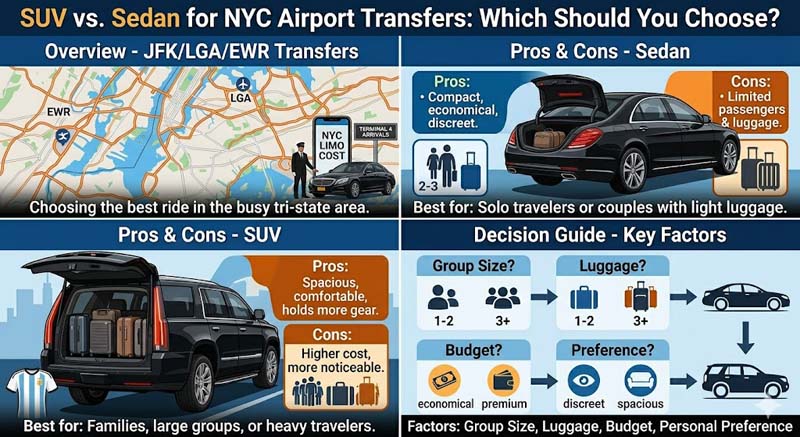
SUV vs. Sedan for NYC Airport Transfers: Which Should You Choose?
When it comes to getting to or from a New York City airport, the vehicle you choose matters more than most people realize. The difference between an SUV and a sedan for NYC airport transfers isn’t just about size — it’s about comfort, logistics, cost, and how smoothly your journey unfolds. Whether you’re heading to JFK, LaGuardia, or Newark, making the right call on vehicle type can set the tone for your entire trip.
Why the Vehicle Choice Actually Matters for NYC Airport Runs
New York City airports are not your average drop-off and pick-up zones. JFK alone handles over 62 million passengers annually, and LaGuardia’s ongoing renovations have reshaped traffic patterns significantly. Newark adds cross-state complexity with NJ Turnpike congestion. In this environment, vehicle choice isn’t a trivial preference — it has real practical consequences.
A sedan that works perfectly for a solo business traveler with a carry-on becomes a logistical headache for a family of four with checked luggage. Similarly, an SUV that comfortably fits six passengers might be unnecessary — and more expensive — for a couple on a weekend getaway. The goal is to match the vehicle to your actual situation, not just pick whichever sounds more premium.
Breaking Down the Sedan Option
Who the Sedan Is Actually Built For
Executive sedans — think Lincoln Continental or Cadillac CT5-class vehicles — are ideally suited for solo travelers or pairs. They’re sleek, easy to navigate through tight airport drop-off lanes, and typically faster to load and unload. If you’re a frequent business traveler who books the same route to JFK every week, a sedan makes complete sense.
The trunk capacity in a professional sedan is designed to handle two standard-sized suitcases comfortably, with room for a carry-on. Beyond that, things get cramped quickly.
Cost Advantages of Going Sedan
Sedans are consistently the more affordable option in the NYC airport transfer market. On average, you can expect sedan rates to run 20–30% lower than comparable SUV bookings on the same route. For a solo traveler doing monthly airport runs, that difference adds up meaningfully over a year.
The fuel efficiency advantage also contributes to lower base rates — something reputable limo and car service companies factor into their pricing structures.
The Limitations Worth Knowing
Be honest about your luggage. If you’re checking two large bags and bringing a suit bag, a sedan’s trunk may not physically accommodate all of it without using the rear passenger seat for overflow — which directly compromises comfort.
Group travel is the other clear limitation. Three passengers can fit in the back of a sedan, but it’s not pleasant for any ride over 30 minutes, especially on a route like Newark to Midtown that can stretch 45–60 minutes in traffic.
The Case for an SUV on NYC Airport Transfers
Space That Actually Changes the Experience
A full-size SUV — such as a Chevrolet Suburban or Cadillac Escalade — typically seats up to six passengers in genuine comfort, with substantial cargo space that remains separate from the passenger cabin. This is a fundamental difference. Luggage goes in the back; people sit comfortably. Nobody has a suitcase pressed against their legs for the entire ride.
For families, groups of colleagues traveling together, or anyone moving between cities with multiple bags, the SUV is simply the more rational choice. A family of four returning from a two-week European vacation with four large suitcases isn’t debating SUV vs. sedan — they need the SUV.
SUVs in NYC Traffic: The Real Picture
There’s a common assumption that bigger vehicles struggle more in New York City traffic. In practice, professional chauffeurs navigate SUVs through NYC corridors daily without issue. The vehicles used by licensed car services are specifically chosen for maneuverability alongside their size.
The bigger variable isn’t the vehicle — it’s the driver’s knowledge of the routes. A skilled chauffeur in an Escalade will outperform an inexperienced driver in a compact car every time on a JFK run during peak hours.
When the SUV Is Worth Every Extra Dollar
Consider this scenario: four colleagues flying into LaGuardia for a Monday morning meeting. Each has a carry-on and a laptop bag. Rather than booking two sedans (double the cost, double the coordination), one SUV handles the entire group seamlessly. In this case, the SUV is not just more comfortable — it’s actually the more cost-effective solution per person.
The math changes entirely when you’re splitting the cost across a group.
Comparing the Two: A Practical Side-by-Side View
Rather than a formal table, think of it this way:
Choose a sedan if:
-
- You’re traveling solo or as a pair
-
- Your luggage fits within two standard suitcases
-
- Budget efficiency is a priority
-
- You’re making a quick, frequent airport run
Choose an SUV if:
-
- You’re traveling with three or more passengers
-
- Your group has four or more pieces of luggage
-
- You want extra space and a more relaxed ride
-
- You’re splitting the cost across multiple passengers
This isn’t about which vehicle is “better” — it’s about which vehicle fits your specific situation on that specific trip.
NYC-Specific Considerations That Affect Your Decision
Airport Layout and Vehicle Logistics
Each NYC-area airport has its own quirks. At JFK, the terminals are spread across a wide campus connected by the AirTrain system, and pickup zones can shift depending on construction and congestion management. An SUV’s higher ride height actually makes it easier to spot in a crowded pickup area — a small but real advantage when you’ve just landed after a long-haul flight.
At LaGuardia, the newly redesigned Central Terminal Building has created more organized pickup infrastructure, but the compact layout means traffic can back up quickly. Neither vehicle type has a significant edge here — driver experience with the terminal layout matters more.
Newark, being across the state line in New Jersey, involves different traffic dynamics entirely. The NJ Turnpike can be unpredictable, and for groups coming in heavy with luggage, the SUV’s additional space makes the longer ride considerably more comfortable.
Licensing and Regulation Standards
In New York, for-hire vehicle services are regulated by the Taxi and Limousine Commission (TLC). Whether you’re booking a sedan or an SUV, the vehicle and driver should be TLC-licensed. This applies to both vehicle types equally and is a baseline expectation — not an upsell.
When evaluating a car service, always confirm TLC licensing regardless of what vehicle class you’re booking. This protects you legally and ensures the driver has met the training and background check standards required by the city.
FAQ: Real Questions About NYC Airport Transfer Vehicle Choice
What is the standard luggage capacity for a sedan vs. an SUV in airport car service?
Most executive sedans comfortably handle two large suitcases in the trunk, plus personal items in the cabin. Full-size SUVs can typically accommodate four to six large bags in the cargo area, keeping the passenger space completely clear. Always confirm specifics with your car service provider when booking.
How do I know if an SUV is worth the extra cost for my trip?
A quick way to think about it: if you’re splitting the cost among three or more people, the per-person price of an SUV often comes close to or matches a sedan. If you’re traveling solo with heavy luggage, the sedan is almost always the better value. The question isn’t which is cheaper in isolation — it’s which is cheaper per person given your group size.
Is it better to book an SUV for Newark airport transfers specifically?
The distance from Manhattan to Newark (typically 45–75 minutes depending on traffic) makes comfort a higher priority than on shorter rides. For groups, the SUV is strongly recommended. For solo travelers, a sedan is perfectly adequate unless you have significant luggage.
What’s the difference between an SUV limo service and a rideshare SUV option?
The vehicles may appear similar, but the service model differs significantly. A professional car service offers pre-scheduled pickups, flight tracking, fixed pricing, and licensed chauffeurs. Rideshare SUV options (like Uber Black SUV) use dynamic surge pricing and offer less predictability on pickup timing — a genuine concern when catching a flight.
Can I request a specific vehicle model when booking an NYC airport transfer?
Many reputable car services allow you to specify preferences, though exact model availability depends on the fleet. It’s worth asking when you book — especially if you have specific luggage or passenger count requirements.
Conclusion
The SUV vs. sedan decision for NYC airport transfers comes down to one straightforward question: what does your trip actually require? Sedans offer efficiency, elegance, and value for solo travelers and pairs. SUVs deliver the space, comfort, and group-travel logic that makes them the smarter choice for families and larger parties.
Neither vehicle is universally “better.” The right answer is always the one that fits your group size, luggage load, route, and budget. Take a minute before you book to assess those four factors honestly, and the decision will make itself.
Ready to Book Your NYC Airport Transfer?
Whether you’re deciding between a sedan and an SUV or just want a straightforward quote for your next trip to JFK, LaGuardia, or Newark, our team is here to help you figure out the right fit — no pressure, just practical advice.
Get in touch with Bubz Limos:
📧 Email us at book@bubzlimos.com
📞 Call or text +1 (929) 541-5558
We’ll walk you through your options, confirm availability, and make sure everything is sorted before your travel date. Reach out whichever way works best for you — we’re happy to help.
Related Posts
 Why Choose an Escalade for Airport Transfers
 Why a Chauffeured Limo Beats Uber for JFK Airport Transfers Every Time
 NYC Airport Transfer with Luxury Sedan
 Armed Driver for Airport Transfers NYC
 Best Limo Service for JFK Airport Transfers in New York City
 Exploring Elite NYC Limousine Services: Unveiling Key Executive Features
 Airport Transfers for Travelers from Miami
 Private Car Service from Rhode Island to JFK